Why MediaWiki is the Best Knowledge Management Software
The grounded argument for MediaWiki as a knowledge platform: history, permission model, extension ecosystem and data ownership, with the honest trade-offs.
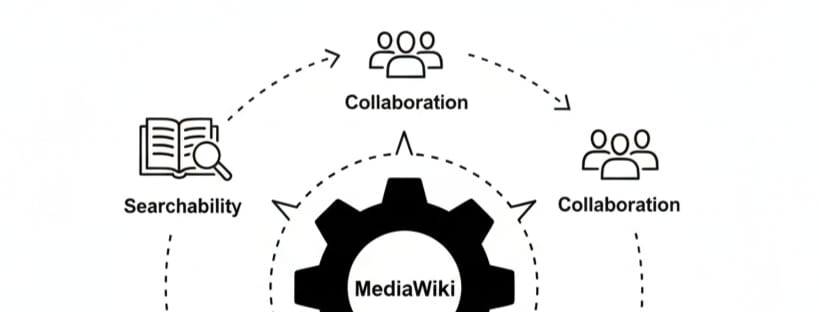
'Best knowledge management software' is a claim no tool should make, and this article won't. What MediaWiki genuinely offers — and why serious teams choose it — is a specific combination: every page permanently versioned, permissions that scale from open wikis to restricted departments, and an extension ecosystem that turns pages into structured data and forms. The wiki model is not for everyone; this is the honest case for when it is right.
The four properties that matter
- Versioned by default — every page carries full revision history with author, timestamp and diff. For policies, procedures and technical documentation this auditability is exactly what compliance asks for and what most tools bolt on as an afterthought
- Collaborative by architecture — MediaWiki is built for hundreds of contributors: watchlists, mentions (Echo/Notifications), discussion pages, change review. Knowledge grows by many small contributions instead of a single owner
- Open data model — content is plain text (wikitext) in a standard database; exports via XML dumps and the API keep the knowledge portable. No vendor lock-in: your knowledge base is a database you own
- Structured when you need it — with Cargo/Semantic MediaWiki and Page Forms, knowledge stops being documents and becomes records with queries: 'all procedures due for review', 'every product owned by X'. Few platforms span both free-form and structured this fluidly
The comparison, honestly
- Vs. Confluence/Jira-style suites — MediaWiki matches the documentation piece at zero license cost and handles many more simultaneous editors; what you give up is polished real-time editing, managed integrations and commercial support
- Vs. Google Docs/Drive — better for co-editing one document, hopeless for structure, versioned diffs at scale, or cross-linking a body of knowledge; the wiki wins for long-lived interconnected content
- Vs. Notion-type tools — closer contenders on UX, but hosted multi-tenant with weaker history depth and data portability; MediaWiki stays self-hosted and fully exportable
Where the wiki model loses
The honest counter-case:
- Real-time co-editing — not what MediaWiki does; simultaneous drafting is a genuine gap
- Office-format output — presentations and newsletters without export tooling are painful
- Maintenance is on you — PHP/MySQL hosting, upgrades and extension hygiene are the hidden cost; Docker Compose reduces it but does not remove it
- Wikitext learning curve — editors need onboarding for anything beyond editing with VisualEditor
The economics
For an organization, the arithmetic is usually: zero license fees versus the engineering time a wiki demands. The break-even point sits surprisingly low — the wiki's maintenance is lighter than the per-seat SaaS renewal of commercial suites once the team size grows, and the data stays on infrastructure you control (a decisive factor in regulated environments and anywhere data residency matters).
The decision framework
- Is the knowledge long-lived and interconnected? → wiki-shaped
- Do many people need to contribute and review? → wiki-shaped
- Does it need an audit trail? → wiki-shaped
- Is real-time co-editing or polished presentation the core need? → not the wiki
MediaWiki is not the best knowledge management software — it is the best open, versioned, contributor-scale knowledge platform, with the trade-offs above. Teams that need those four properties find nothing else that combines them; teams that don't, shouldn't pay the wiki tax. The manual and a Docker Compose pilot will tell you which group you belong to within a weekend.